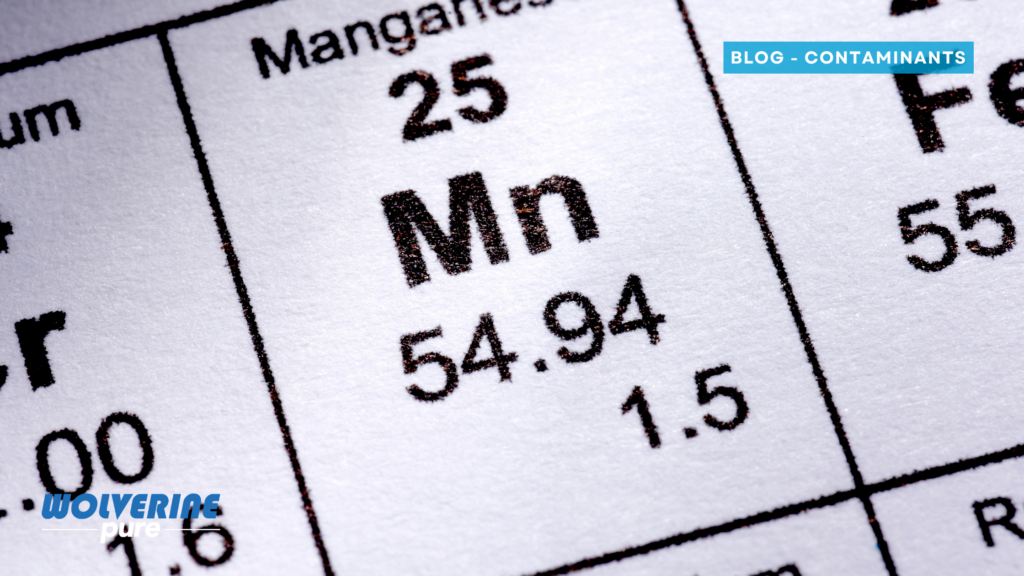
Manganese doesn’t usually make it to the top of the list of home water quality concerns. But recently, scientists have been ringing the alarm bells about manganese contamination in groundwater. At high enough levels, manganese can have a toxic effect on the brain and central nervous system, especially in children.
In water, manganese contamination can appear as small black flecks. It can also cause the water itself to be tinted black or dark brown. Sometimes, but not always, it has a metallic taste.
As of 2026, manganese is considered a secondary contaminant by the U.S. Environmental Protection Agency (EPA). This means that while the EPA has provided some guidelines for manganese contamination levels in water, these guidelines are not federally mandated. It’s up to individual states and water municipalities to test for and report excess manganese.
Let’s take a closer look at this contaminant and find out what you can do to protect your family’s water.
What is Manganese?
Manganese is a naturally occurring element found in the Earth’s crust. Humans need a small amount of manganese in our diet to maintain healthy bone density, support connective tissues, assist with blood clotting, and boost nerve function. We can get our daily dose of manganese through leafy greens (kale, spinach, etc.), legumes, shellfish, and whole grains.
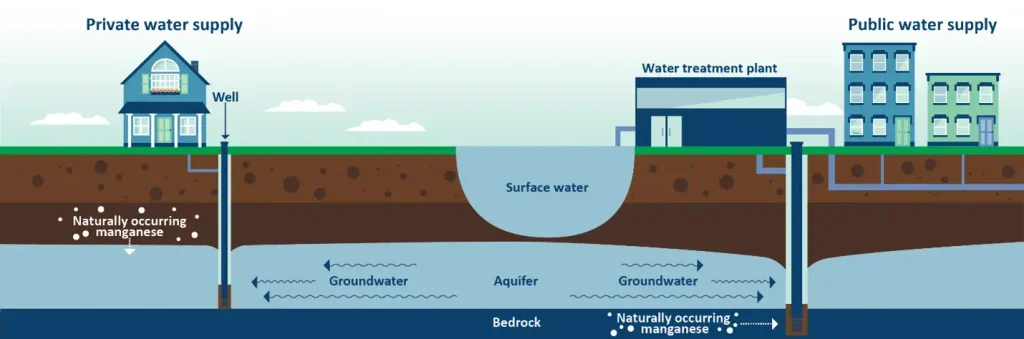
However, like all minerals, exposure to too much manganese can be toxic. Excess manganese can enter the water supply through groundwater absorption, especially in locations that are close to industrial or mining facilities.
How Does Manganese Affect My Health?
Research into manganese water contamination has ramped up in the last few years as scientists seek to understand how it impacts human health. While there are many research studies examining the effects of inhaling manganese dust (common in industrial jobs, like welding or mining), there aren’t many long-term studies on manganese contamination in water.
Similar to other heavy metals, like lead and arsenic, manganese contamination can impact the brain. Children who are exposed to high levels of manganese can experience lower IQ scores, poor academic performance, slurred speech, and other neurological challenges. Adults who are exposed to excessive levels of manganese can experience neurological issues that resemble Parkinson’s disease, including tremors and cognitive decline.
Manganese in Michigan’s Water
According to a report by Harvard Public Health Senior Editor Christine Mehta, the EPA estimates that manganese is present in 2% of drinking water in the US. While this number may seem small, it still represents tens of thousands of homes. And since manganese is not a mineral that requires annual testing by the Safe Drinking Water Act, its real contamination levels are likely underreported.
Manganese is naturally present in rocks and soil in the state of Michigan, which means it does make its way into Michigan drinking water. If you have discolored water, visible black flecks in your water, or black stains in your toilet or sink, you may have manganese contamination.
Keeping Your Family Safe from Manganese
Your water is vital to your home and your health. We want to help you make sure it’s clean and safe.
Wolverine Water has more than 75 years of experience handling Michigan’s water challenges. Our whole-home water purification systems are especially designed to manage heavy metals so every tap in your home has pure, fresh water.
If you need a lower-budget option, we also offer point-of-use reverse osmosis systems to help keep your drinking water free from heavy metals and unwanted contaminants. We’ll test your water before and after to show you the difference your Wolverine Water system is making for your home.
Contact us today to get started.